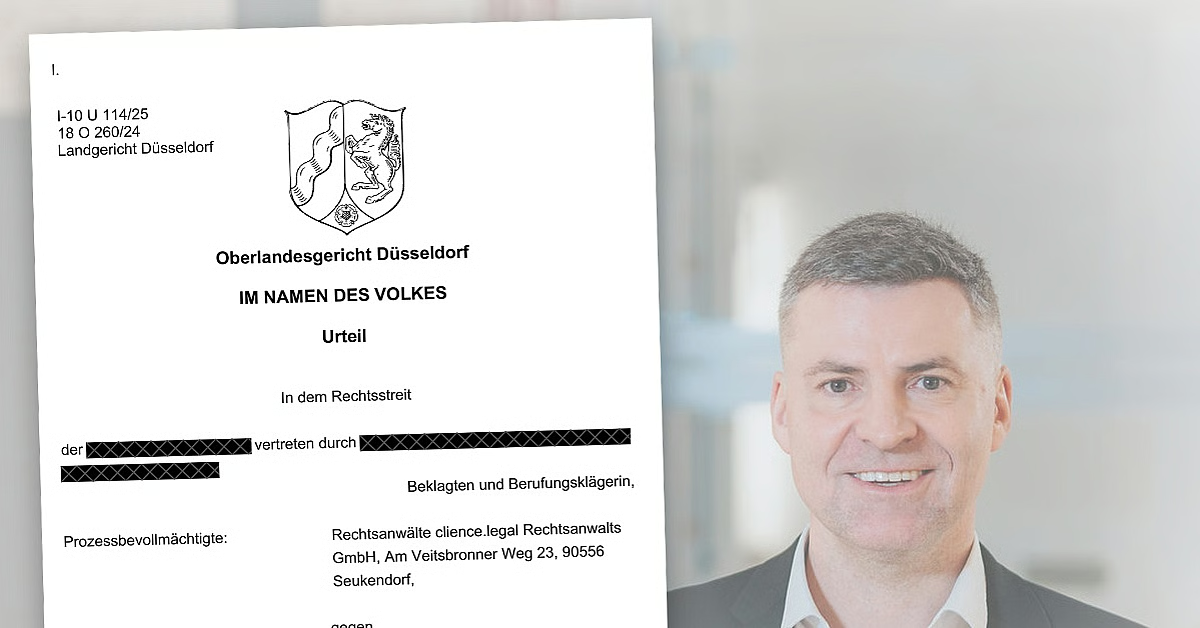
A customer books a coaching program, is very satisfied with the work and later still demands the entire fee back. Exactly this situation was at the heart of proceedings in which our client had lost at first instance. He instructed us to represent him in the appeal before the Higher Regional Court of Düsseldorf.
The result: the action for repayment was dismissed in full.
Higher Regional Court (OLG) of Düsseldorf, Case I-10 U 114/25, judgment following the oral hearing of October 8, 2026. Leave to appeal on points of law (Revision) was not granted.
The most important information at a glance
- Complete success in the appeal: The Higher Regional Court of Düsseldorf has reversed the judgment of the Regional Court of Düsseldorf and dismissed the lawsuit for the reimbursement of the coaching fee.
- Not automatic: Video lessons, live calls, or a WhatsApp group do not in themselves turn coaching into distance learning.
- The focus of the contract decides: What matters are the specific scope of services agreed upon and the nature of the services.
- Burden of proof lies with the client: Anyone who relies on the FernUSG must present and prove its prerequisites. Blanket claims are not sufficient.
- Unconscionability not established either: The objection that the fee was excessive also failed for lack of specific submissions.
- Costs borne by the plaintiff: The customer bears the costs of both instances.
For many coaches and mentors, the current developments surrounding the Distance Learning Protection Act (FernUSG) are a significant burden. Some customers demand their money back years after the contract was concluded, often arguing that the coaching was distance learning requiring approval.
However, not every such claim is justified, and not every coaching program automatically falls under the FernUSG. Our recent success before the Higher Regional Court of Düsseldorf shows why it can be worthwhile to have such a claim rigorously reviewed and, if necessary, fended off.
Lost completely at first, then won on all counts
Our client successfully offers a business coaching program and had supported a customer over an extended period. The program included, among other things, personal support, live calls, video content, entrepreneur days, and individual support with business issues.
The customer took advantage of the services and, according to the information available to us, was initially extremely satisfied. However, later he demanded the full reimbursement of the agreed and already paid remuneration.
His central argument was that the coaching was a distance learning contract within the meaning of the FernUSG. Since the provider did not have the required approval, the contract was void.
The Düsseldorf Regional Court largely followed this argument at first instance. It relied on the brief description of the services provided and the contract and generously interpreted the wording and elements contained therein as distance learning.
For our client, this was a significant setback. He had performed his services and was still required to pay back the remuneration received. After the defeat, he commissioned clience.legal to file the appeal.
We thoroughly examined the facts and, above all, the legal requirements of the alleged claim for repayment, and worked out the decisive arguments for the appeal proceedings. The Higher Regional Court of Düsseldorf then amended the first-instance judgment and dismissed the action in its entirety. The plaintiff bears the costs of both instances; leave to appeal on points of law was not granted.
Higher Regional Court (OLG) of Düsseldorf, Case I-10 U 114/25, amending the judgment of the Regional Court (LG) of Düsseldorf of August 27, 2025, Case 18 O 260/24.
Why the Higher Regional Court of Düsseldorf rejected the refund claim
The question at the center of the case was whether the contractual services actually constituted distance learning within the meaning of the FernUSG. The Regional Court had previously upheld this interpretation. The Higher Regional Court, however, concluded that the prerequisites for a distance learning contract could not be sufficiently established.
The panel made clear that what matters is the specifically agreed scope of services and the focus of the contract. The fact that a coaching program includes video lessons, live calls, or a WhatsApp group is not in itself sufficient to assume a distance learning contract.
Likewise, the mere designation of a service as a step-by-step instruction does not necessarily mean that the paid provision of knowledge and skills constitutes the main focus of the contract. What matters is which services were actually agreed upon and what their nature is. In the specific case, the court held that it was not sufficiently established that the requirements of the FernUSG were met.
Burden of presentation and proof lies with the client
An express finding of the court is particularly important: the burden of presentation and proof for the requirements of a distance learning contract lies with the customer. Blanket assertions about alleged learning content or supposed monitoring of learning success were not sufficient in the proceedings.
The unconscionability objection failed too
The argument that the agreed fee was unconscionably excessive was also unsuccessful; here, too, specific submissions were lacking. There was therefore no claim to repayment of the coaching fee.
What other coaches can draw from the decision
In our view, the judgment is an important signal for coaching providers. In public discussions, the impression sometimes arises that virtually any digital coaching contract with video courses, recorded live calls, or WhatsApp support is automatically invalid without approval, and customers could easily demand their payment back. The legal situation is not that simple.
The Federal Court of Justice has confirmed in several decisions that the FernUSG applies to certain coaching offerings. But this by no means implies that every business coaching, management consulting or mentoring program with digital elements is distance learning requiring approval. Each contract has to be assessed on its specific content and the services agreed. We give an overview of the BGH's line of case law in our article on the BGH ruling on the FernUSG and online coaching; the order in which the three statutory criteria are tested is set out in our FernUSG check for coaches.
Anyone who receives a refund claim should therefore neither pay hastily nor hope that the claim will go away on its own.
Five recommendations for coaches facing refund claims
1. Take claims seriously without being intimidated
If a client or their attorney requests a refund based on the FernUSG, that does not yet mean that a claim actually exists. Let specialized lawyers review the claim based on your specific contract. A negative judgment can slow down or even endanger your entire coaching program, for example if it is published online in your name.
2. Secure contract documents and communication
Contract documents, service descriptions, content of sales discussions, messages and documentation are crucial for legal evaluation. Especially the actual structure of the coaching relationship can provide important clues as to whether the focus was on knowledge transfer or on individual advice and support.
3. Do not underestimate the correct legal argument
In coaching law, details often matter. Distinguishing between knowledge transfer, management consulting, and personal mentoring requires careful legal review. It is just as important to correctly assess the burden of presentation and proof and the procedural requirements.
4. Do not give up too quickly after a defeat
Our case shows that even after losing at first instance, significant options for defense may remain. Because of the procedural requirements, however, an appeal is no foregone conclusion. That makes it all the more important to have the judgment reviewed early for errors of law and admissible grounds of appeal.
5. Structuring the business model in a legally sound manner
The best dispute is the one that never arises. Coaches should therefore have their contract drafting, their sales processes, and the actual delivery of their programs reviewed by specialists in coaching law. With this certainty and clear processes, you can focus entirely on your coaching. We show what matters here in our overview of the Contract drafting for online coaching contracts and the typical problems with online business coaching contracts.
Why choosing the right law firm can be crucial
Coaching law can no longer be handled reliably with a superficial contract review. It involves the interplay of contract law, the Distance Learning Protection Act (FernUSG), current case law, sales models, and the particularities of digital coaching offerings. In addition, there are procedural questions that can carry considerable weight in court proceedings.
Our success before the Higher Regional Court in Düsseldorf shows how important it is to carefully examine the specific contractual arrangements and to conduct the proceedings accordingly. We are convinced that anyone who provides high-quality services as a coach deserves equally high-quality legal advice and representation.
Our goal is not to fight at all costs. We consistently represent legitimate interests, reject unfounded claims, and seek economically reasonable solutions.
Our goal: reduce the risk of refunds and enable growth
clience.legal does not only assist coaches, mentors, and consulting companies when clients are already demanding a refund. Our goal is to position our clients in a way that legally avoidable refund risks are virtually eliminated.
For this, we do not only consider individual contractual clauses, but the entire business model. We examine how coaching programs are advertised and sold, what services are contractually agreed upon, how the support actually takes place, and what legal requirements result from this. Based on this, we develop individual solutions that reduce legal risks while simultaneously supporting entrepreneurial development.
No one can or should guarantee that a refund claim will never arise. Careful legal structuring can, however, reduce many avoidable risks and better secure revenue in the long term. Successful coaching businesses need a legal foundation that fits their business model, protects their economic interests and leaves room for healthy growth. Read more in our Legal advice on the FernUSG for online coaches.
Are you a coach whose client is demanding their money back? Perhaps you have just received a lawyer's demand letter, perhaps court proceedings are already under way, or, like our client, you lost at first instance. Have your case reviewed by a law firm experienced in coaching law. We also support coaches who want to protect their offerings and sales processes legally in advance. Briefly describe your situation in a free initial consultation, and we will discuss the sensible next steps with you. You can find the bigger picture in our overview of online coaching law.
Note: This article describes a specific court decision and our experience from this engagement. How other coaching contracts are to be assessed depends on the circumstances of the individual case. The litigation success described does not guarantee the outcome of other proceedings.
FAQs
What did the Higher Regional Court of Düsseldorf decide in case I-10 U 114/25?
By judgment of October 8, 2026, the Higher Regional Court of Düsseldorf amended the judgment of the Regional Court of Düsseldorf of August 27, 2025 (Az. 18 O 260/24) and dismissed in its entirety a coaching customer’s action for repayment of the fee. The plaintiff bears the costs of both instances. Leave to appeal on points of law was not granted.
Is every online coaching program distance learning requiring approval?
No. The FernUSG only applies if the characteristics of § 1, paragraph 1 of the FernUSG are present: the paid provision of knowledge and skills, predominant spatial separation, and monitoring of learning progress. Whether this is the case depends on the specifically agreed service scope and the focus of the contract and must be examined individually for each contract.
Are video lessons, live calls, or a WhatsApp group enough for the FernUSG to apply?
In the opinion of the Düsseldorf Higher Regional Court, these elements alone are not sufficient to conclude that a distance learning contract exists. Even the designation of a service as a step-by-step instruction does not necessarily imply that the provision of knowledge constitutes the main focus of the contract. What is decisive is the nature of the services actually agreed upon.
Who has to prove that a distance learning agreement exists?
The burden of presentation and proof for the requirements of the FernUSG lies with the customer who relies on it. The Higher Regional Court of Düsseldorf expressly held that blanket assertions about alleged learning content or supposed monitoring of learning success are not sufficient. Specific submissions on the agreed services are required.
What does the focus of the contract mean?
This refers to whether the coaching is primarily aimed at imparting knowledge and skills or at individual advice and support for the client. If the focus is on personal advice, for example on specific business issues, this argues against distance learning. The distinction is made on the basis of the contract and the agreed services.
What are the consequences if a coaching program actually falls under the FernUSG?
If the required approval is lacking, the contract is void under § 7(1) FernUSG. The customer can then, in principle, reclaim the fee paid under the rules on unjust enrichment. That is precisely why it is important to check carefully whether the statutory requirements are actually met in the individual case.
Does the FernUSG also apply if the customer is a business?
Yes. The Federal Court of Justice has already ruled in a judgment of June 12, 2025 (Case III ZR 109/24) that the FernUSG is not limited to consumers but applies to contracts with entrepreneurs as well. Therefore, the customer’s entrepreneurial status does not protect the provider. What matters remains whether the characteristics of distance learning are present in the specific contract.
Is an appeal worthwhile after a defeat in the first instance?
It can be, as the proceedings before the Higher Regional Court of Düsseldorf show. However, because of the procedural requirements, an appeal is not a foregone conclusion. The appeal must be filed within one month of service of the judgment, and the grounds of appeal must be submitted within two months. The judgment should therefore be examined early for errors of law and admissible grounds of attack.
What documents should coaches secure when facing a repayment claim?
Above all, the contract, the description of services, documents and content from sales conversations, communication with the customer, and records of the support actually provided. These documents show which services were agreed and whether the focus was on knowledge transfer or on individual advice. They form the basis of any defense.
When is it worth hiring an attorney for a coaching repayment claim?
At the latest when an attorney’s demand letter arrives or a lawsuit is filed, you should have the claim reviewed before you pay or respond. We assess your contract in light of current case law, evaluate the prospects of success, and represent you both out of court and in court. A preventive review of the contract, sales process, and program structure is also worthwhile, so that avoidable risks do not arise in the first place.